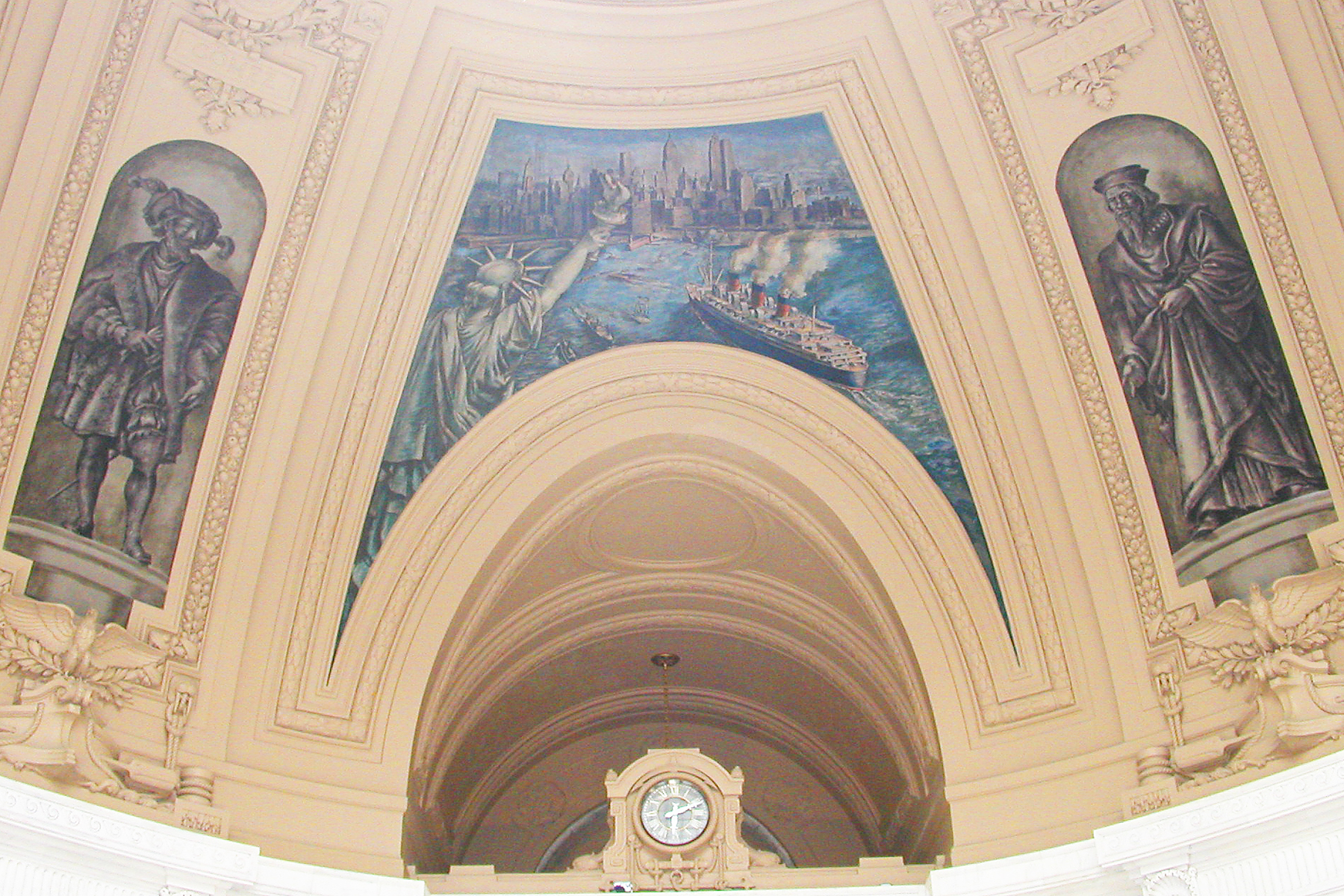
In 1936, Reginald Marsh was commissioned to execute a series of murals in the Rotunda as part of the Treasury Relief Art Project, which gave work to artists during the depression. The larger ones display eight views of the activity at the port of New York. Eight smaller panels, depicting figures of famous explorers, are painted in grisaille to simulate statuary. The fifth mural panel depicts a panoramic view of New York Harbor and the city skyline with the Statue of Liberty in the left foreground. In the right foreground, the RMS Queen Mary is heading for port. This scene is meant to demonstrate the centrality and prominence of New York as both an international port of call and a center for immigration. By the mid1930s there were over two hundred international steamship routes using New York Harbor; a major vessel sailed into or departed from the harbor every ten minutes during daylight hours. The fact that Marsh chose to depict foreign-flag vessels in the Custom House murals, and not solely American superliners, greatly displeased Joseph P. Kennedy, the chairman of the United States Maritime Commission. He complained to Secretary of State Henry Morgenthau, Jr., the senior head of TRAP, who was forced to come to Marsh’s defense. Morgenthau told Kennedy that Marsh chose to show foreign vessels in the murals because they accurately represented the liners visible in New York Harbor at the time. He said that Marsh had used the Scottish-built Queen Mary in particular “because he feels that any painting of present-day New York Harbor omitting this Blue Ribbon liner would not be a complete, nor accurate one.”