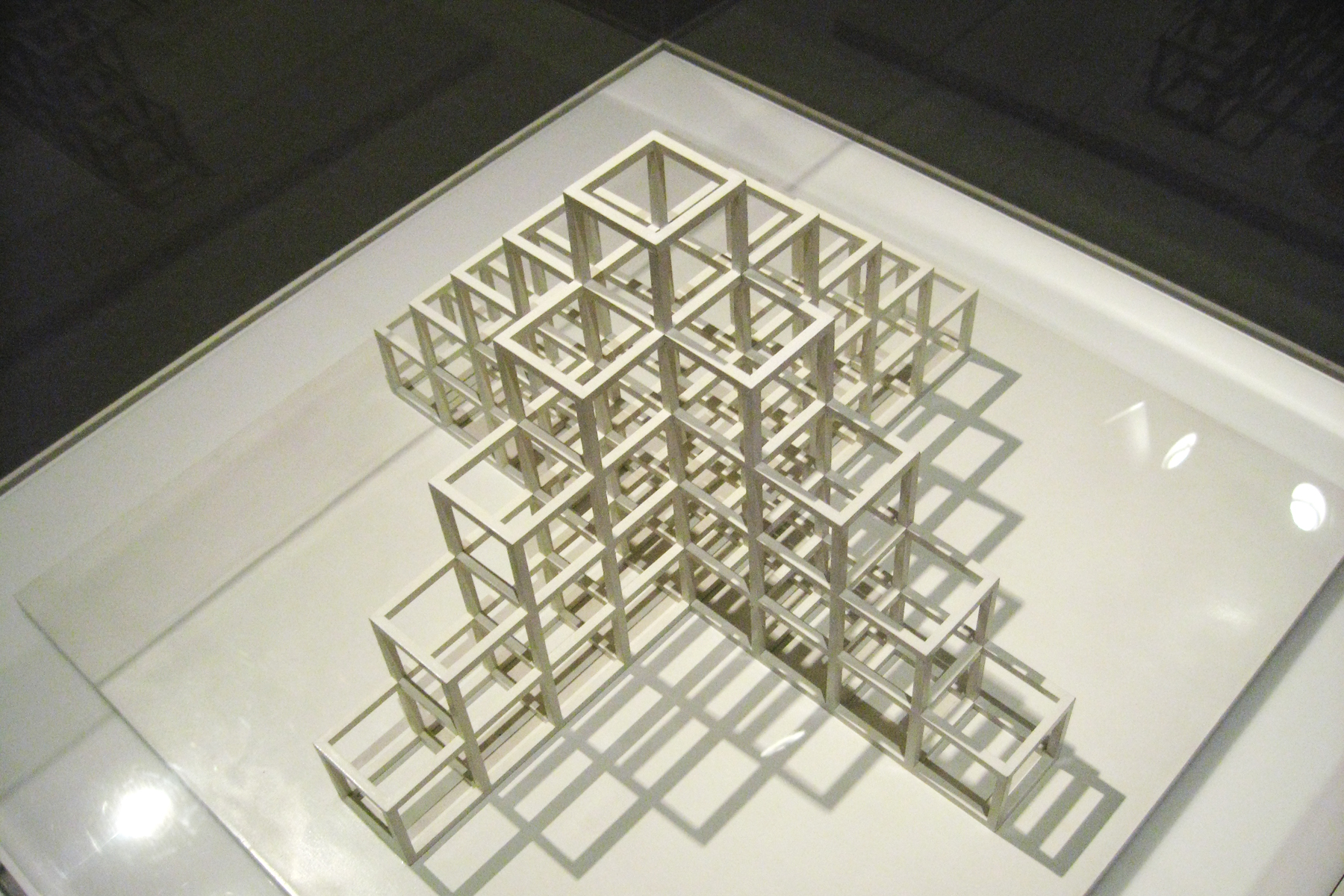
Untitled, by Sol LeWitt Sol LeWitt was a pioneer of both Minimalism and Conceptualism, two key artistic developments of the 1960s and 1970s. Minimalism emphasized geometry and modularity, while Conceptualism privileged ideas over objects and process over product. Methodical, austere, and emotionally restrained, LeWitt’s sculptures generally consist of three-dimensional grids whose proportions are based on those of the smallest individual unit and whose overall configuration is deduced from pre-determined ratios and formulas. Such a technique was intended to relieve the artist from having to invent, compose, and express. Despite the complex mathematical calculations it entailed, this approach was too intuitive, absurd, and compulsive to merit the term logical. “Conceptual artists,” LeWitt wrote in 1969, “are mystics rather than rationalists. They leap to conclusions that logic cannot reach.”