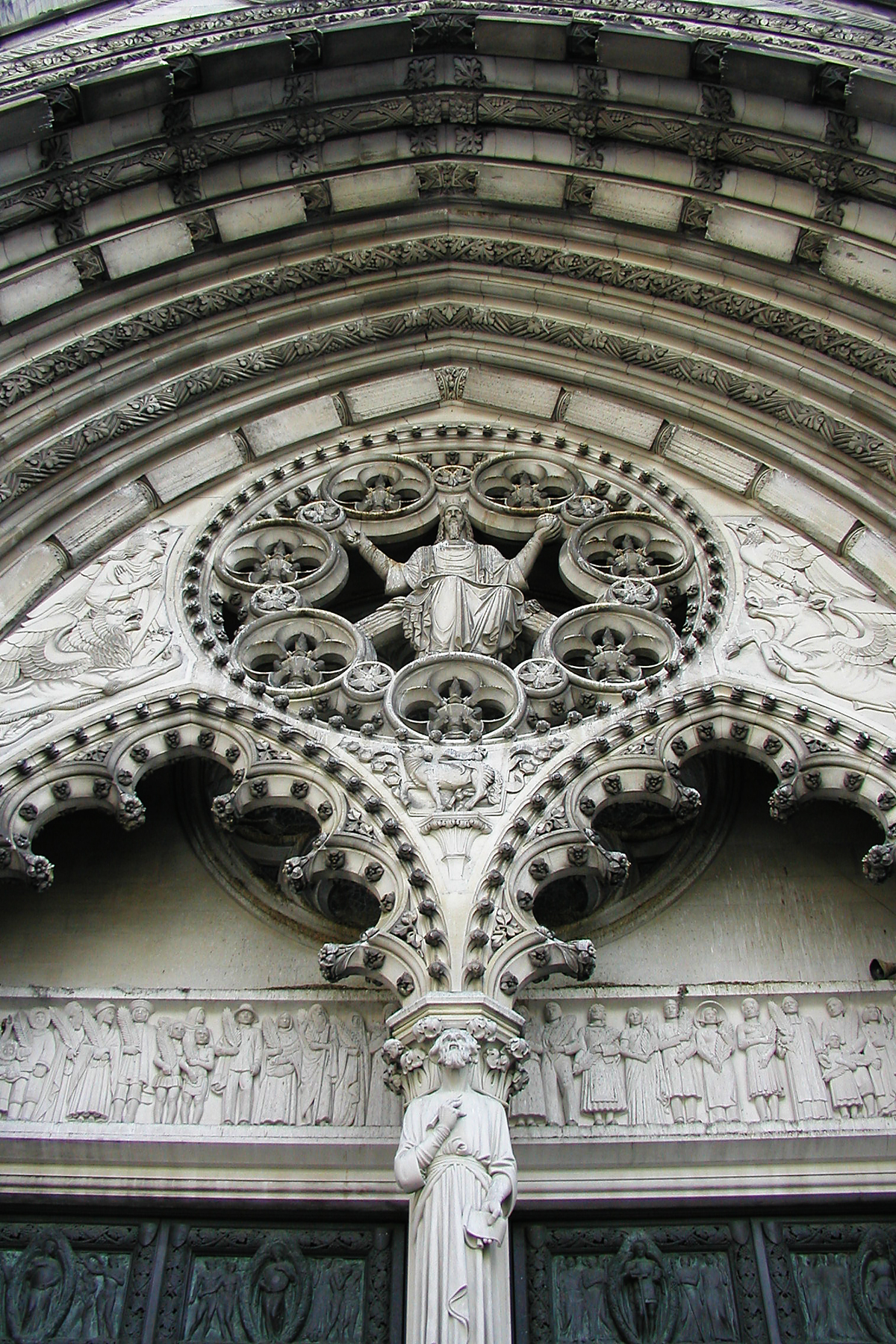
Façade above the Great Bronze front doors to the Cathedral Church of Saint John the Divine on 112th Street and Amsterdam Avenue in N.Y.C. The Great Bronze doors were cast by Barbedienne of Paris who also cast the Statue of Liberty. The 3-ton bronze doors below this portal are decorated with relief castings of scenes from the Old Testament on the left and the New Testament on the right. The doors are opened only twice a year: on Easter and in October for the Feast of St. Francis. The Cathedral Church of Saint John the Divine was begun in 1892, the same year as Ellis Island was opened. In 1911 the East End of the Cathedral was dedicated. Thirty years later, in 1941, the nave’s 601-foot length was unveiled in dedication ceremonies that took place one week before the bombing of Pearl Harbor. Construction ceased and would not be resumed for almost forty years. The greatest challenge to construction was the lack of stonemasons. A school for stonemasons was established, training masons in exchange for work on the cathedral. They began the South Tower in 1979 but financial issues and a severe fire in 2001 have slowed progress. The beauty of this church is not in its grandeur, however, but in its principle. It was dreamed of as a great inclusive American cathedral. Its charter declares it to be “a house of prayer for all people and a unifying center of intellectual light and leadership.” In fact the chapels rounding the altar are known as the Seven Chapels of the Tongues and represent the seven major immigrant groups that influenced the growth of this great city at the turn of the century. Each chapel is dedicated to a particular immigrant nationality and the architecture and adornment in each chapel reflects the culture and history of each nation. The Chapel of Saint Ansgar is dedicated to Scandinavian immigrants; Saint Columba to the people of the British Aisles; Saint Ambrose to the Italian immigrants; and Saint James to the Spanish immigrants. The Chapel of Saint Boniface is dedicated to the German immigrants and boasts a larger-than-life bronze statue of Germany’s patron saint, Saint Michael the Archangel. The Chapel of Saint Savior was originally the Belmont Chapel after its benefactor but later dedicated to the people of the East. Lastly, the Chapel of Saint Martin is dedicated to French immigrants and the influence of France on Christian Europe and pays homage to Saint Joan of Arc with a statue of her that stands upon a rough stone from the cell in Rouen where she was imprisoned before her execution. It is inspiring to see a ‘church’ built and dedicated in the name of gathering all people together in the name of prayer. In addition to the Chapels of the Seven Tongues, two 12 foot menorah’s stand upon either side of the altar; which also boasts two enamel vases gifted from Japan and two gilded teak prayer chests from the King of Siam; the windows represent the seven churches in Asia Minor; the baptistry, built in the traditional octagon shape, is adorned with carvings illustrating Dutch history; the Choir pavement is a mosaic representative of the new Jerusalem; the Choir stalls are adorned with statues that represent historic figures associated with Sacred music from around the world; and the parapet depicts figures whose lives and works shaped history including Assisi, Columbus, Shakespeare, and Lincoln, and more recently, Martin Luther King, Albert Einstein, and Mohandas Gandhi. The entire cathedral is truly a multi-national, multi-generational testament to the single tribe of man.