2005-08-06: Bus Tour of NYC:
-
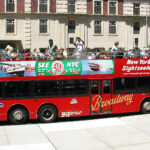
- PGK Art: New York Sightseeing Bus Tour
-
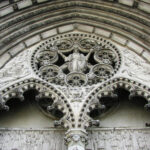
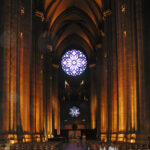
- Façade above the Great Bronze front doors to the Cathedral Church of Saint John the Divine on 112th Street and Amsterdam Avenue in N.Y.C. The Great Bronze doors were cast by Barbedienne of Paris who also cast the Statue of Liberty. The 3-ton bronze doors below this portal are decorated with relief castings of scenes from the Old Testament on the left and the New Testament on the right. The doors are opened only twice a year: on Easter and in October for the Feast of St. Francis. The Cathedral Church of Saint John the Divine was begun in 1892, the same year as Ellis Island was opened. In 1911 the East End of the Cathedral was dedicated. Thirty years later, in 1941, the nave’s 601-foot length was unveiled in dedication ceremonies that took place one week before the bombing of Pearl Harbor. Construction ceased and would not be resumed for almost forty years. The greatest challenge to construction was the lack of stonemasons. A school for stonemasons was established, training masons in exchange for work on the cathedral. They began the South Tower in 1979 but financial issues and a severe fire in 2001 have slowed progress. The beauty of this church is not in its grandeur, however, but in its principle. It was dreamed of as a great inclusive American cathedral. Its charter declares it to be “a house of prayer for all people and a unifying center of intellectual light and leadership.” In fact the chapels rounding the altar are known as the Seven Chapels of the Tongues and represent the seven major immigrant groups that influenced the growth of this great city at the turn of the century. Each chapel is dedicated to a particular immigrant nationality and the architecture and adornment in each chapel reflects the culture and history of each nation. The Chapel of Saint Ansgar is dedicated to Scandinavian immigrants; Saint Columba to the people of the British Aisles; Saint Ambrose to the Italian immigrants; and Saint James to the Spanish immigrants. The Chapel of Saint Boniface is dedicated to the German immigrants and boasts a larger-than-life bronze statue of Germany’s patron saint, Saint Michael the Archangel. The Chapel of Saint Savior was originally the Belmont Chapel after its benefactor but later dedicated to the people of the East. Lastly, the Chapel of Saint Martin is dedicated to French immigrants and the influence of France on Christian Europe and pays homage to Saint Joan of Arc with a statue of her that stands upon a rough stone from the cell in Rouen where she was imprisoned before her execution. It is inspiring to see a ‘church’ built and dedicated in the name of gathering all people together in the name of prayer. In addition to the Chapels of the Seven Tongues, two 12 foot menorah’s stand upon either side of the altar; which also boasts two enamel vases gifted from Japan and two gilded teak prayer chests from the King of Siam; the windows represent the seven churches in Asia Minor; the baptistry, built in the traditional octagon shape, is adorned with carvings illustrating Dutch history; the Choir pavement is a mosaic representative of the new Jerusalem; the Choir stalls are adorned with statues that represent historic figures associated with Sacred music from around the world; and the parapet depicts figures whose lives and works shaped history including Assisi, Columbus, Shakespeare, and Lincoln, and more recently, Martin Luther King, Albert Einstein, and Mohandas Gandhi. The entire cathedral is truly a multi-national, multi-generational testament to the single tribe of man.
-
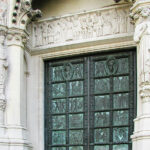
- Left Great Bronze front doors — the Great Bronze doors were cast by Barbedienne of Paris who also cast the Statue of Liberty. These doors are decorated with relief castings of scenes from the Old Testament.
-
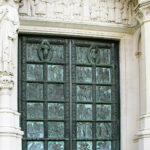
- Right Great Bronze front doors — the Great Bronze doors were cast by Barbedienne of Paris who also cast the Statue of Liberty. These doors are decorated with relief castings of scenes from the New Testament.
-
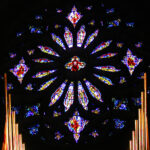
- Stained glass Rose Window at the Cathedral Church of St. John the Divine. The Christ figure at its center is life-size at 5 foot 7 inches tall.
-
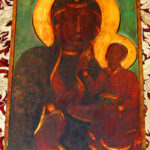
- Black Virgin icon at the Cathedral Church of Saint John the Divine
-
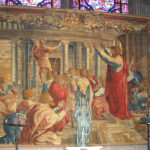
- Background: One of nine English tapestries based on the Acts of the Apostles after cartoons (painted designs for tapestries) by Raphael; Foreground: Statue; at the Cathedral Church of St. John the Divine
-
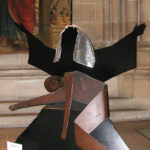
- “Pieta for Darfur and Iraq” metal sculpture by Frederick Franck at the Cathedral Church of St. John the Divine
-
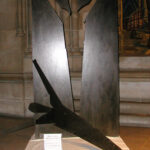
- “Death and Resurrection” metal sculpture by Frederick Franck at the Cathedral Church of St. John the Divine
-
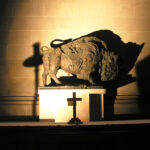
- Native American Buffalo sculpture at the Cathedral Church of St. John the Divine
-
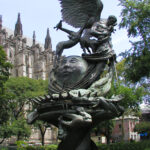
- The Peace Fountain sculpture by Gregg Wyatt. It depicts the struggle between good and evil. The forces of good, embodied in the figure of the archangel Michael, triumph by decapitating Satan, whose head hangs from one side. The fountain is encircled by small, whimsical animal figures cast in bronze from pieces sculpted by children.
-
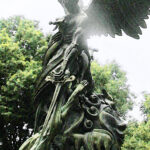
- The Peace Fountain sculpture by Gregg Wyatt; it depicts the struggle of good and evil — the forces of good, embodied in the figure of the archangel Michael, triumph by decapitating Satan.
-
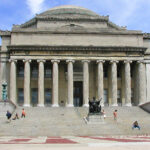
- Low Library at Columbia University; capped by the largest freestanding granite dome in the United States. NOTE: “King’s College Founded In The Province Of New York By Royal Charter In The Reign of George II Perpetuated as Columbia College by the State of New York When They Became Free and Independent – Maintained and Cherished from Generation to Generation For the Advancement of the Public Good and the Glory of Almighty God”
-

- Krysia at Columbia University
-
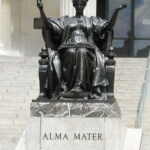
- Alma Mater is a sculpture of the goddess Minerva by Daniel Chester French on the outdoor steps leading to Low Memorial Library on the campus of Columbia University.
-
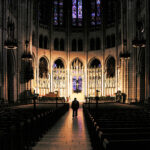
- Riverside Church
-
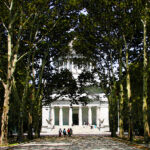
- General Grant National Memorial a/k/a Grant’s Tomb — West 122nd Street & Riverside Drive, N.Y.C.
-
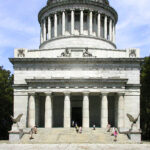
- General Grant National Memorial a/k/a Grant’s Tomb: This memorial to Ulysses S. Grant, victorious Union commander of the Civil War, includes the tomb of General Grant and his wife, Julia Dent Grant. Approximately 90,000 people from around the country and the world donated a total of over $600,000 towards the construction of his tomb, the largest public fundraising effort ever at that time. Designed by architect John Duncan, the granite and marble structure was completed in 1897 and remains the largest mausoleum in North America. Over one million people attended the parade and dedication ceremony of Grant’s Tomb, on April 27, 1897.
-
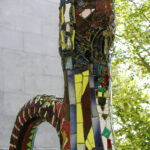
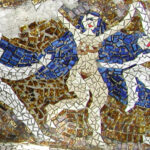
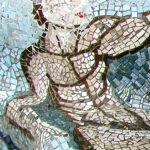
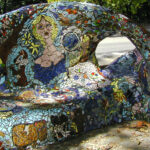
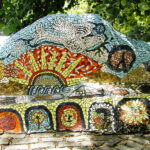
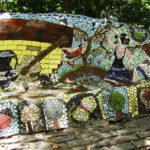
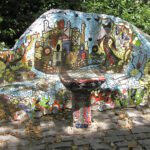
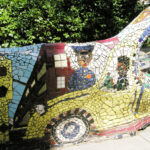
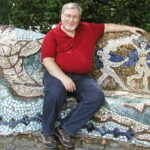
- In 1973, Pedro Silva and the City Arts Workshop created colorful mosaic benches, done by children, around the General Grant National Memorial’s plaza, intended to beautify the site. However, this addition was criticized by some for having little to do with the Memorial monument and for detracting from its architectural and aesthetic character.
-
- Pawel
-
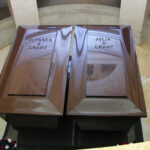
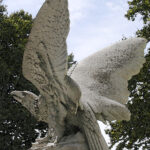
- General Grant National Memorial is the largest tomb in North America. Over a million people had attended Grant’s funeral parade, held in 1885 and which was seven miles long and featured Confederate and Union generals riding together in open victorias, U.S. President Grover Cleveland, his cabinet, all the Justices of the Supreme Court, and virtually the entire Congress. “As one by one withdraw the lofty actors From that great play on history’s stage eterne That lurid, partial act of War and peace—of old and new contending, Fought out through wrath, fears, dark dismays, and many a long suspense; All past—and since, in countless graves receding, mellowing, Victors and vanquish’d—Lincoln’s and Lee’s—now thou with them, Man of the mighty days—and equal to the days! Thou from the prairies!—tangled and many-vein’d and hard has been thy part, To admiration has it been enacted!” by Walt Whitman ============================ A riddle relating to Grant’s Tomb, popularized by Groucho Marx on his game show You Bet Your Life, is “Who is buried in Grant’s Tomb?” The proper answer is “nobody”—Grant and his wife are not buried
-
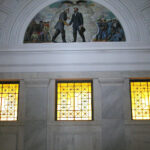
- Mural by Allyn Cox (1896–1982), installed in 1966.
-
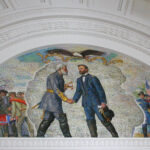
- Mural by Allyn Cox (1896–1982), installed in 1966: a scene of Robert E. Lee surrendering to Grant at Appomattox Court House
-
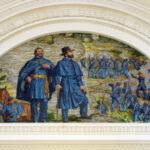
- Mural by Allyn Cox (1896–1982), installed in 1966: Grant on Missionary Ridge, to the right of General George H. Thomas (November 25, 1863).
-
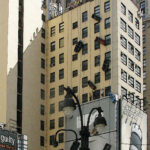
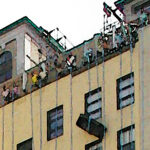
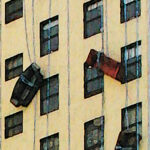
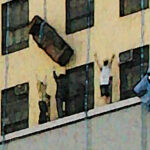
- HBO advertisement sculpture on the side of a building on 34th Street, as seen from Seventh Avenue: “The Hoisting Of Couches” [Note: All of those “people” in the ad are mannequins.]
-
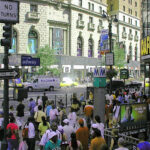
- PGK Art: Life on 34th Street and Broadway in New York City
-
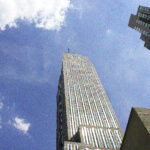
- PGK Art: The Empire State Building reaching out to heaven

-

-
The End; To Exit, enter the “Esc” Key
or
