Good evening Prince William (and Daniel, Catherine, Michael & Baby Girl Y) (and your parents), (and any future descendants and their parents),
Let me tell you about Babcia Krysia’s Grandmother (one of your eight Great-Great-Grandmothers), Apolonia Wegleswska (nee Kosinska).
Apolonia was one of eleven children, daughter of Antoni Kosinski and his first wife, Ludwika Kosinska nee Lagiewka.
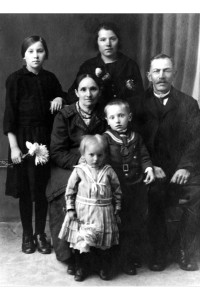
Helena & Wladzia; Ludwika & Antoni; and Leonarda (Lesia) & Ignacy
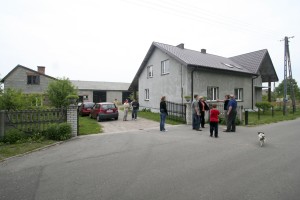
May 18, 2006: Visit to the house in Turek where Apolonia grew up; and her daughter Irena vacationed during her childhood summers.
Antoni Kosinski d: Turek, Poland
…… + Ludwika Lagiewka b: 1880, d: 01 May 1928 in Turek, Poland
………… Jozefa Kosinska b: 18 Dec 1902
………… + Roch Krzeminski
………… Janina Kosinska
………… Leonarda “Lesia” Kosinska
………… + ? Kluza
………… Apolonia Kosinska b: 07 Jan 1904 in Kilania, Poland, d: 20 Oct 1979 in New York, New York
………… + Michal Weglewski
………… Marianna (Marysia) Kosinska b: 29 Aug 1904, d: 25 Jul 2000 in Turek, Poland
………… + Jozef Drzewiecki b: 1896, d: 13 Mar 1983 in Turek, Poland
………… Helena Kosinska b: 1911, d: 20 Nov 2005 in Turek, Poland
………… Stanislawa Kosinska
………… Viktoria Kosinska b: 1916, d: 03 Aug 1982 in Turek, Poland
………… + Leonard Lament b: 1915, d: 21 Apr 1983 in Turek, Poland
………… Wladyslawa Kosinska d: 01 Mar 1996 in Torun, Poland
………… Zofia Kosinska b: 08 Jul 1918 in Kilania, Poland, d: 15 Aug 1989 in Turek, Poland
………… + Stanislaw Marciniak b: 20 Apr 1920 in Turek, Poland, d: 08 Feb 1969 in Turek, Poland
………… Ignacy Kosinski b: 1920, d: 14 Jun 1989 in Turek, Poland
………… + Jozefa Danisz b: 1902, d: 10 Feb 1967 in Turek, Poland
…… + Aniela Rusek
………… Monika Kosinska b: 1933, d: 02 May 2006
………… + Czeslaw Paruszewski b: 1932
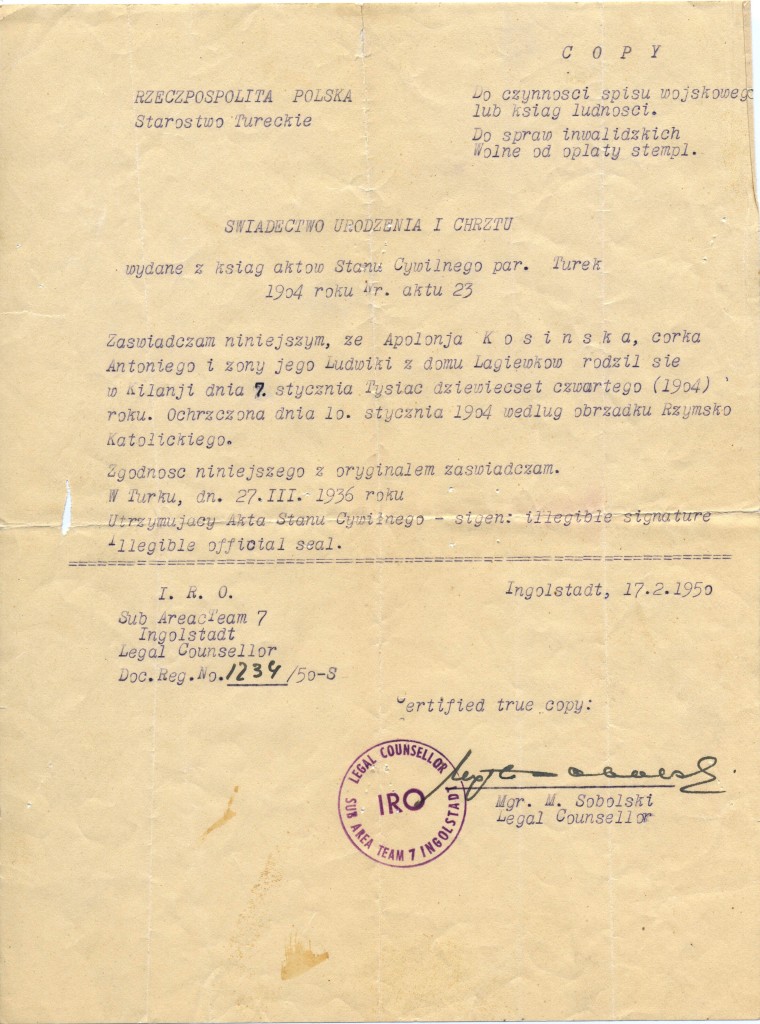
Apolonia Weglewska nee Kosinska - Certificate of Birth and Baptism
Certificate of Birth and Baptism
Based on the Civil Register from the Parish in Turek
1904 year, document number 23
I hereby certify, that Apolonia Kosinska, daughter
of Antoni and his wife Ludwika from the house of Lagiewka was born
in Kilania on the 7th of January 1904.
She was baptised on the 10th of January 1904 in accordance with the Roman
Catholic Church.
==============
Apolonia’s father was a farmer.
Because the farm work could not support them, Apolonia left the family farm in about 1920, with her sister Jozefa — they went to France to look for domestic work.
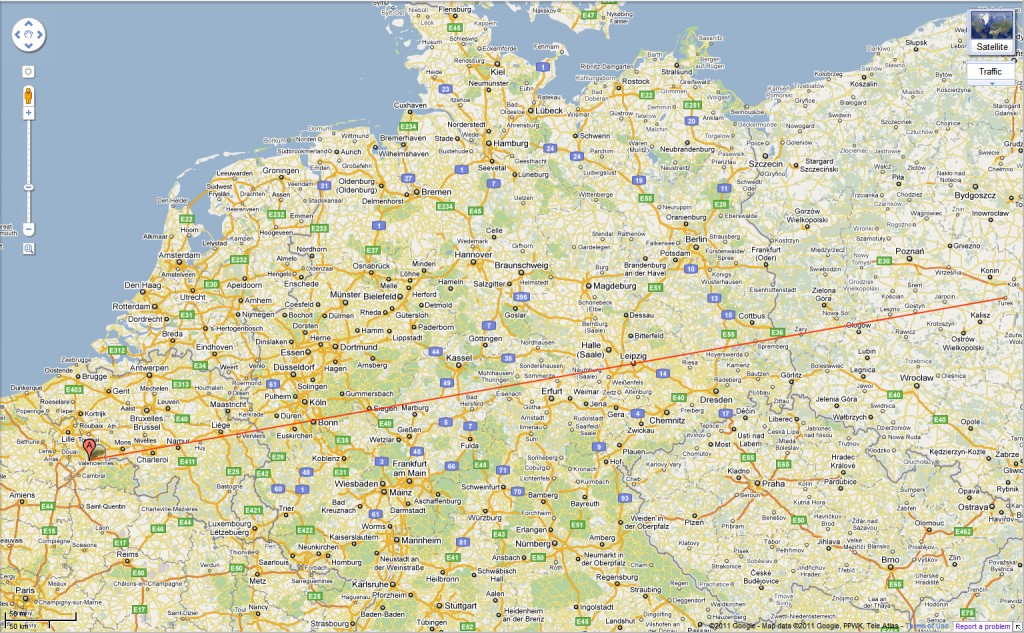
In France, Apolonia met Michal Weglewski, a scrap metal merchant — they married on April 25, 1925, in Denain, France.
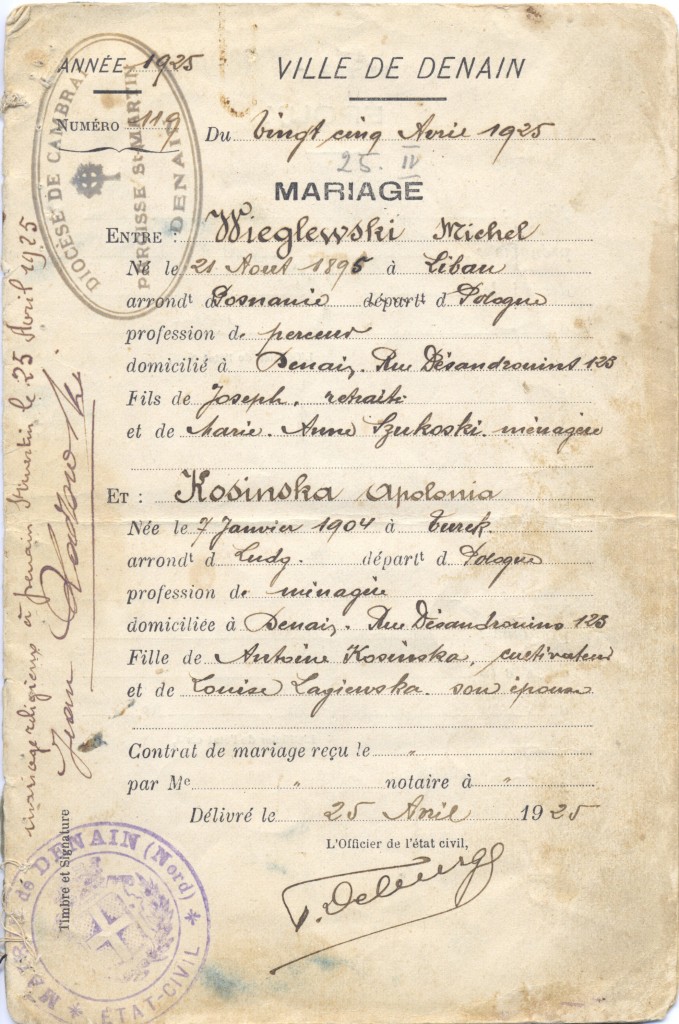
Certificate of Marriage (in French)
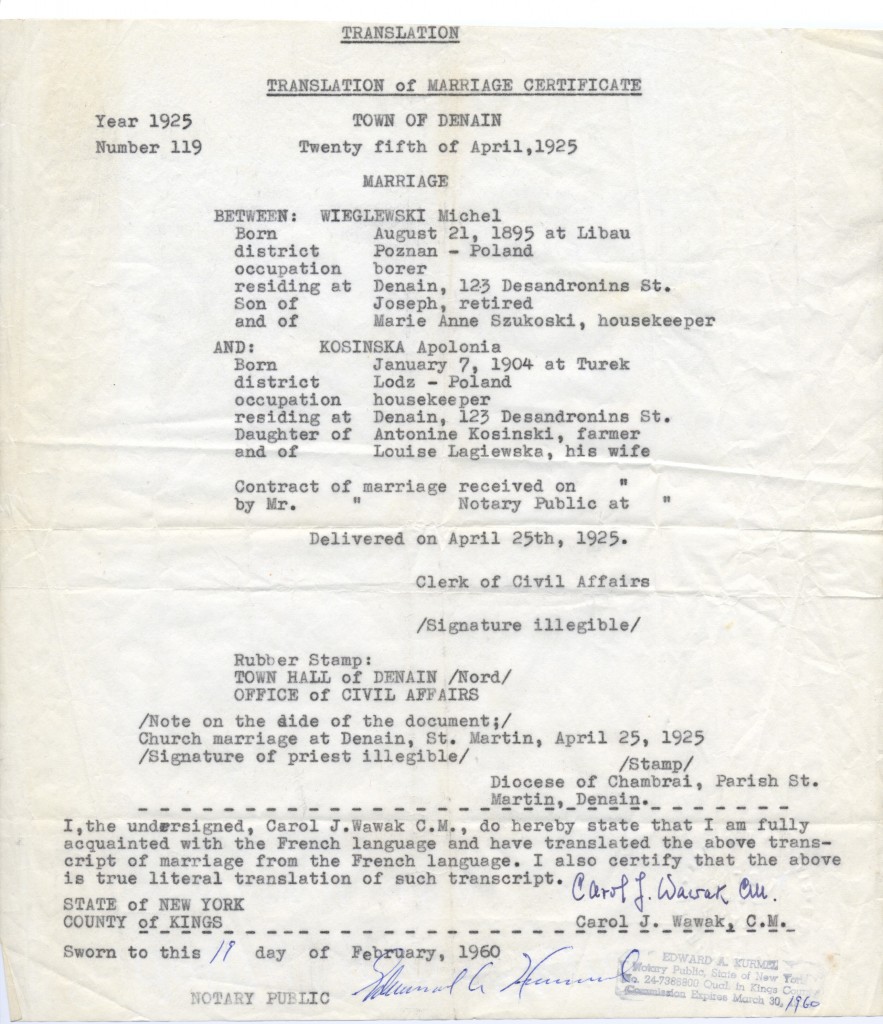
English Translaton of French Certificate of Marriage
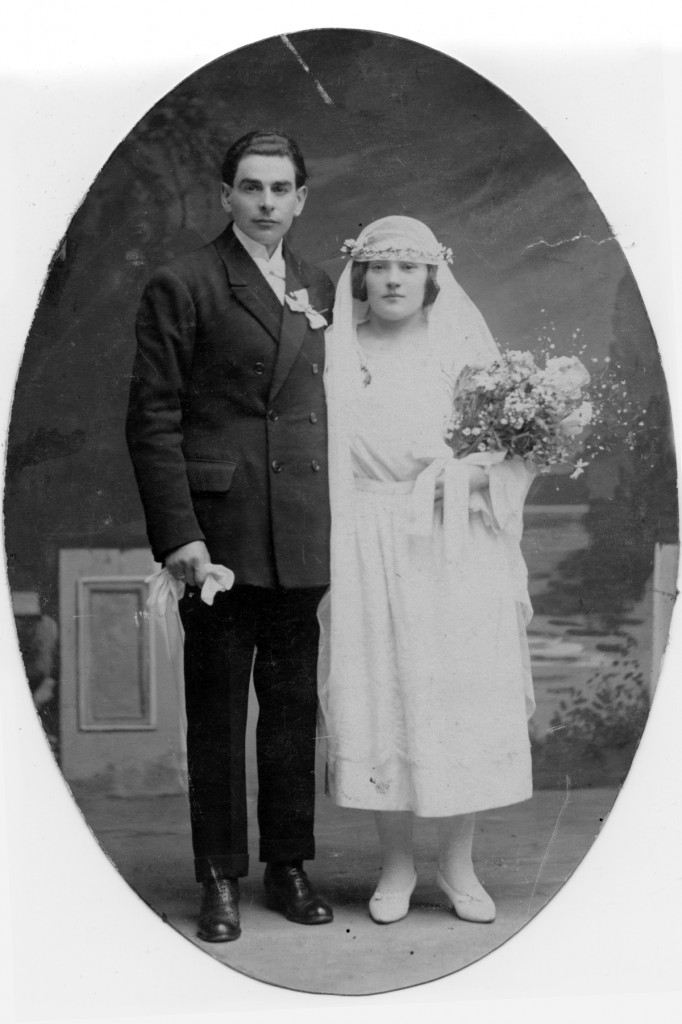
Michal Weglewski and Apolonia Kosinska
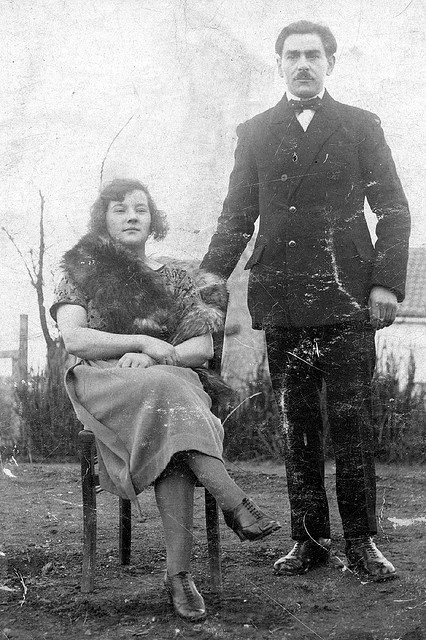
Apolonia Weglewska ne Kosinska & her husband, Michal Weglewski
Sometime prior to March 1927, Apolonia and her husband Michal returned to Poland, and settled in Wrzesnia. There, they had two children: Irena (one of your four Great-Grandmothers, and her brother, Jan, who eventually settled in Canada).
These are the descendants of Apolonia and Michal:
1 Apolonia Kosinska b: 07 Jan 1904 in Kilania, Poland, d: 20 Oct 1979 in New York, New York
…… + Michal Weglewski b: 21 Aug 1895 in Libau, Poznan, Poland, m: 25 Apr 1925 in Denain, St. Martin, France, d: Nov 1935 in Wrzesnia, Poland
…………2 Irena Weglewska b: 16 Mar 1927 in Kilania, Poland
………… + Henry Aleksander Neumann b: 11 Apr 1923 in Tuchola, Poland, m: 30 Mar 1951 in Greenpoint, Brooklyn, New York, d: 25 Mar 1979 in Brooklyn, Kings, New York, USA
………………3 Christine Mary Neumann b: 04 Apr 1952 in Greenpoint, Brooklyn, New York
……………… + Paul George Kostro b: 09 Jan 1949 in Buenos Aires, Argentina, m: 03 Jun 1972 in Greenpoint, Brooklyn, New York
……………………4 Mark Kostro b: 21 Feb 1974 in Hollis, Queens, New York, USA
…………………… + Kelly Ladd b: 19 May 1970 in Newport News, VA, m: 11 Oct 2003 in Williamsburg, James, Virginia, USA
…………………………5 William Ladd Kostro b: 28 May 2011 in Williamsburg, James, Virginia, USA
……………………4 Richard Alexander Kostro b: 03 Dec 1975 in Hollis, Queens, New York, USA
……………………4 Margaret Rose Kostro b: 24 Jun 1980 in Summit, Union, New Jersey, USA
…………………… + John Sasieta b: 19 Aug 1974 in Newark, Essex, New Jersey, USA
………………3 Ann Irene Neumann b: 10 May 1955 in Queens Co., New York
……………… + Lee Douglas Levine b: 27 Mar 1954 in Bangor, Maine, m: 13 Apr 1983 in Suffolk County, New York
……………………4 Alina Zoe Levine b: 30 Dec 1988 in New York, NY
……………………4 Sarah Michael Levine b: 25 Jun 1992 in New York, NY
………………3 Tadeusz Henryk Neumann b: 22 Apr 1958 in Queens, New York
………………3 Michael Alexander Neumann b: 28 Nov 1962 in Greenpoint, Brooklyn, New York, d: 13 Jan 1985 in Florence, KY
…………2 Jan Weglewski b: 08 Feb 1929, d: 24 Sep 1979 in Sudbury, Ontario, Canada
………… + Kazimiera Capinska b: 08 Mar 1931, m: 1950 in Canada
………………3 Henryk Jan Weglewski b: 04 Dec 1949
……………… + Resemary Fleming b: 23 Jun 1948
………………3 Jozef Kazimierz Weglewski b: 16 Mar 1954, d: 04 Dec 1990
………………3 Janina Irena Weglewski b: 03 Apr 1956
……………… + Craig Loyd Taylor b: 02 Dec 1955
……………………4 Stacy Andrea Taylor b: 02 Apr 1983
………………3 Andrew Tadeus Weglewski b: 13 Nov 1960
……………… + Elizabeth Miszczak b: 14 Jul 1960
……………………4 Christina Alicja Weglewski b: 08 Feb 1997
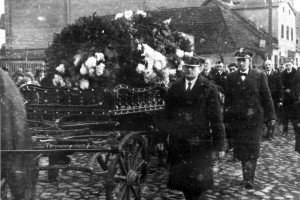
Funeral march of Michal Weglewski; Wrzesnia, 1935
Michal died of tuberculosis in 1935.
After the start of World War II (September 1, 1939), goods were rationed. To purchase food and clothing, the buyer had to present a rations card which limited the amount that could be purchased.
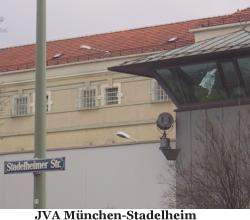
JVA Stadelheim - Munich's prison
In 1943, Irena found such a card lying on the floor in a store. She took it home, and gave it to her mother. Apolonia decided to use this rations card to purchase some cloth; however, the police were waiting to see who would try to use the missing card, and arrested her. As a consequence, fifteen year old Irena was sent to jail for six weeks; and Apolonia was sent to Stadelheim prison in Munich, Germany for over a year. Her two children, Irena (15-years old) and Janek (13-years old) had to fend for themselves during that time.
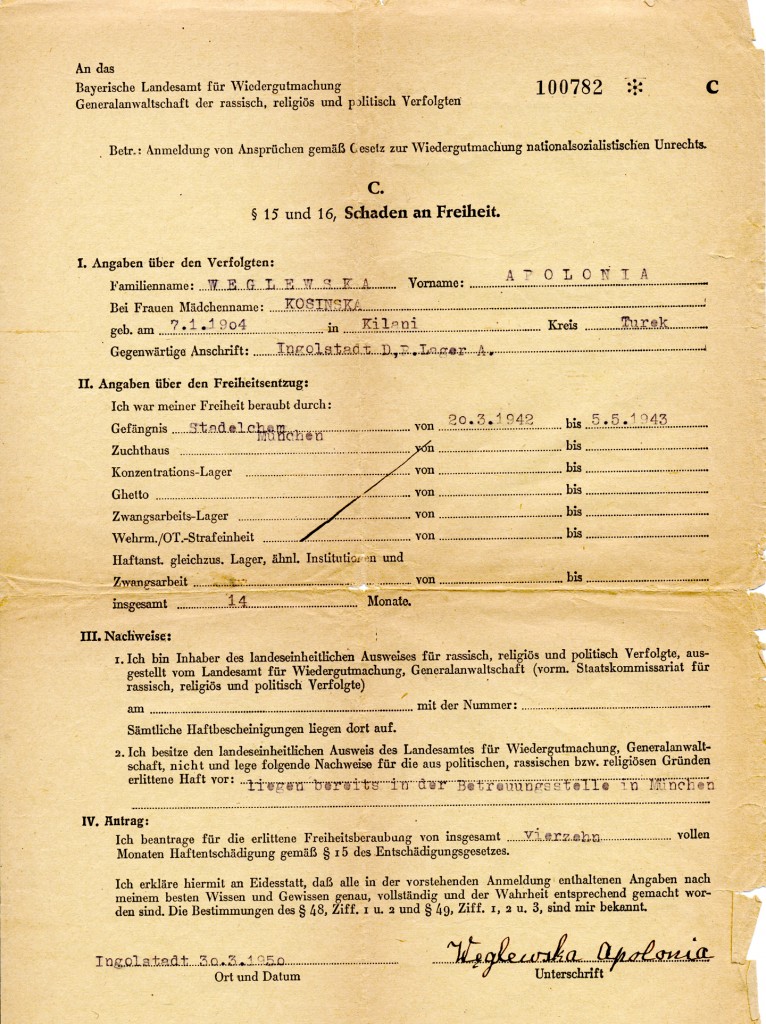
JVA Stadelheim prison in Munich -- March 20, 1942 to May 5, 1943
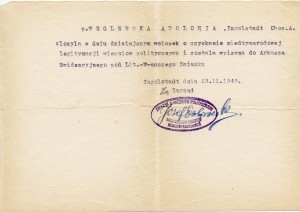
Apolonia Weglewska recognized as a Political Prisoner
After the war, it was recognized that Apolonia had been imprisoned as a Political Prisoner.
Mrs. Apolonia Weglewska, Ingolstadt, Camp A
submitted today a request to be granted an international
identification as a political prisoner and was entered into the records
under the letter W of our Organization.
Ingolstadt, November 18, 1949
Per the governing body
Organization of Political Prisoners
of German Concentration Camps
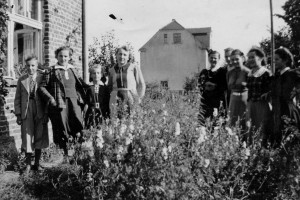
Wrzesnia 1941: Left to right, Kazimierz Stencel, Mrs. Stencel, Maryla Stencel, Mrs. Stencel's sister Frania. Cousin Stefania Weglewska, Janina Weglewska, Apolonia and Irena Weglewska
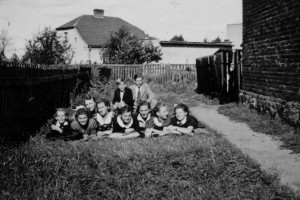
Wrzesnia 1941: Weglewski house in the background, Stencel house on the right side and both families posing in the Stencel yard.
While Apolonia was in jail, Mrs. Stencel (a back yard neighbor) looked out for Irena and Jan.
In an effort to avoid being deported by the Germans, Irena was given a job by a local gardener to work in a park. During that time, the Germans took all their possessions. They lived at a friend’s house in a cold attic.
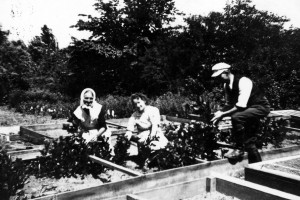
Pani Solecka, Apolonia Weglewska, and Mr. Dobrucki working in a nursery in Wrzesznia.
When Apolonia was finally released from jail, she returned to her children in Wrzesnia. Because they did not have any place to live, they were allowed to sleep in a toolshed in the yard of a relative. But then, in 1944, they were expelled by the Germans. They were amongst 1,300 people that were put on a train, and were taken to Germany.
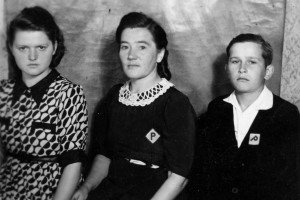
Irena, Apolonia and Jan Weglewski -- sent to Germany as labor slaves; Note the "P" on their chests -- while in Germany, as slaves, they were required to wear this at all times, so they would stand out and not be allowed to blend in to local society.
At one point, Irena was segregated into a group of women that were to be taken for medical experimentation. However, at her mother’s direction, when the guard was distracted and not looking, Irena quickly left that group, and rejoined the group that her mother and brother were in. An elderly German farmer took an interest in Janusz because he needed a strong young man to help him operate the farm. All three of them were taken to work on the farm, for no pay, just the food that they would receive.
Their duties started at 4 a.m., at which time they had to prepare food for and feed the animals — the pigs and cows. Then, after breakfast, they would go into the fields and do seasonal work — cut hay, gather potatoes and beets, rain or shine. This was very hard work, and very cold in the winter. They did not have any clothing available and their skin was constantly exposed to the elements.
Initially they ate their meals with the farmer’s family; but when the local police became aware of this, this practice was forbidden. By now, they had learned to speak German fairly well; however, they were required to wear a “P” badge on their clothes at all times so that everyone would know that they were not German, but Polish slaves. This went on until they were liberated by the American army in 1945.
Once liberated, they were sent to a Displaced Persons’ Camp in Ingolstadt, near Munich, Germany. While there, Irena went to a Polish high school in Munich; and then, after skipping a grade, graduated from high school in Ingolstadt. After completing high school, Irena went on to complete her secondary education (“Liceum”) in Ingolstadt; and passed her final exams, called “Matura.”
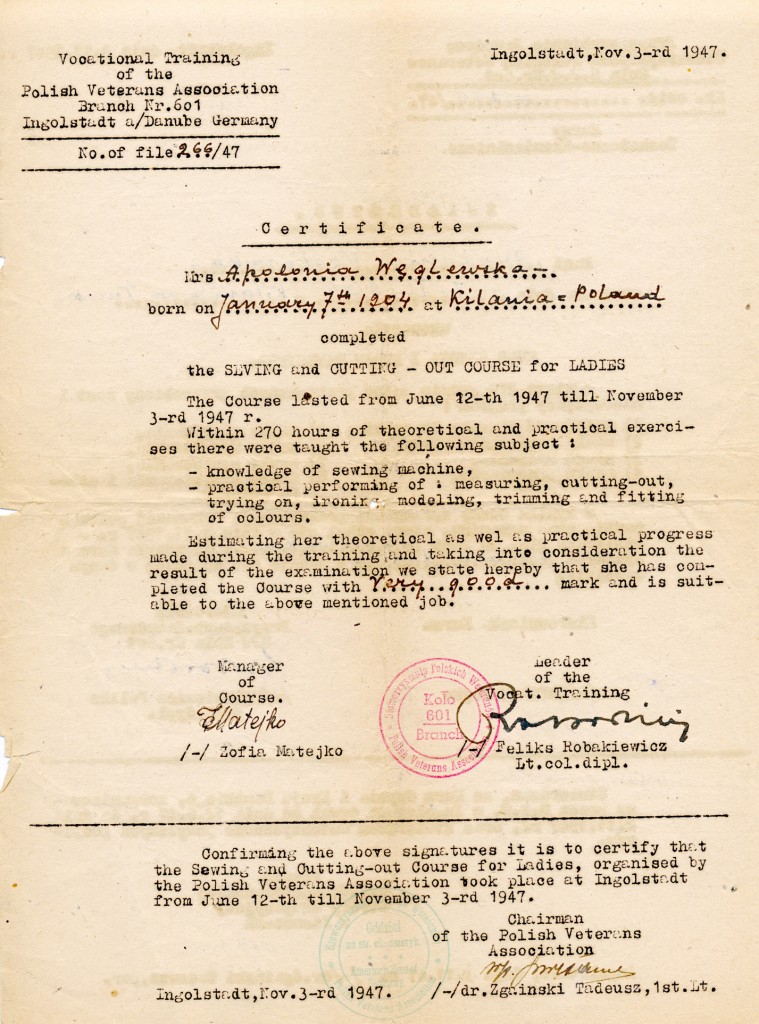
Vocational Training Certificate -- Sewing and Cutting-Out Course for Ladies
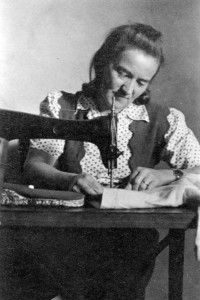
Apolonia Weglewska
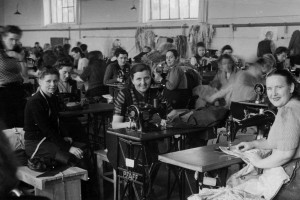
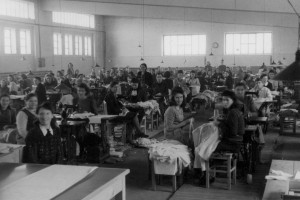
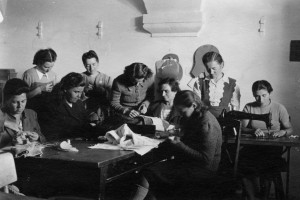
Because they had nothing in Poland; and because the Communists took over the country, Apolonia and her children, Irena and Jan, sought to emigrate out of Europe. Irena’s brother was accepted by Canada, to work in the nickel mines near Sudbury. At the DP Camp, Apolonia had a job making pajamas out of parachutes — these parachutes were covered in a chemical, which infected and deformed Apolonia’s hand when she accidentally pricked herself with a needle. Because of this hand deformity, no country wanted to accept her.
However, when Irena agreed in writing to be financially responsible for her mother, a relief organization made arrangement fo Irena and her mother to travel to America. Irena was to be a chambermaid and Apolonia was to be a cook for a church in Washington, D.C.
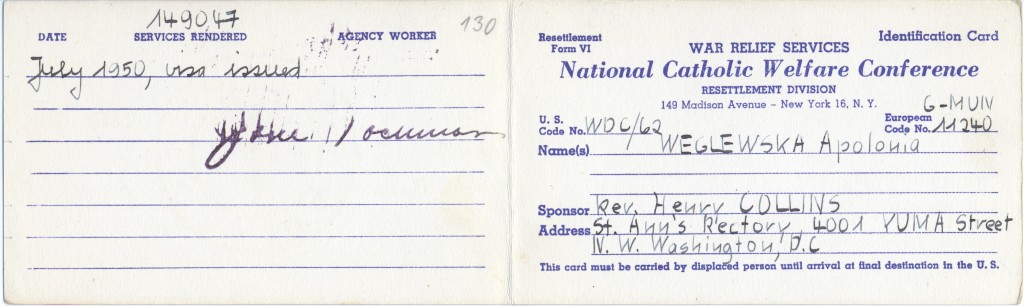
July 1950 - Resettlement to the United States
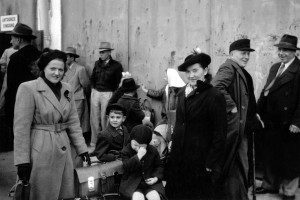
Departure for America
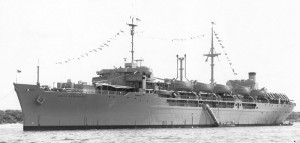
USS General R. M. Blatchford (AP-153)
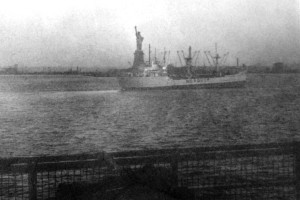
Nov 1, 1950 -- first sighting of New York from the USNS General R. M. Blatchford (T-AP-153). Bremerhaven > Halifax > New York
When they arrived in New York, in November 1950, they were met by a priest from the parish in Washington — however, when he saw that Apolonia’s hand had been deformed, he decided not to accept Apolonia and Irena into his employ; thus they were relieved from their contract (and from the obligation to pay for their passage to America).
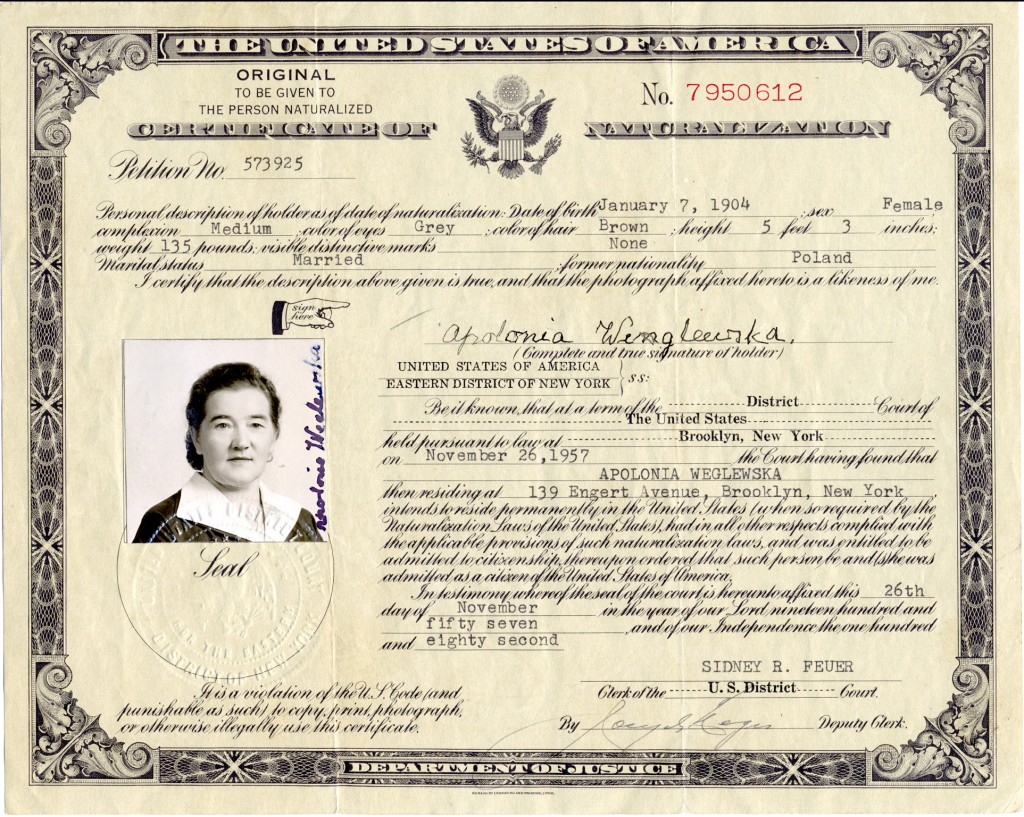
Apolonia Weglewska became a United States Citizen on November 26, 1957
Apolonia Weglewska spent her entire life in the United States living with her daughter Irena and Irena’s husband Henry Neumann, and their four children; she took care of her grandchildren, Babcia Kryisa, Hania, Tadeusz & Michal, while their parents went to work.
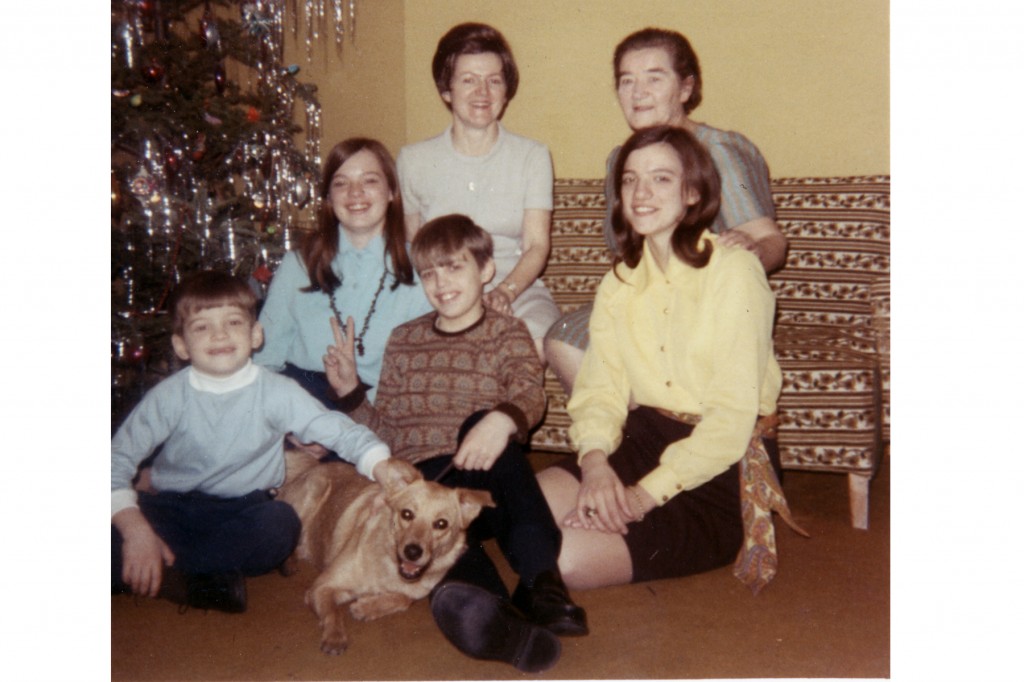
1969 Christmas: Michal, Hania, Tadziu, Irena, Apolonia & Krysia
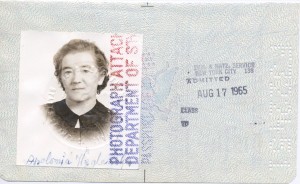
After visiting Poland, Apolonia Weglewska returned to the U.S. on August 17, 1965
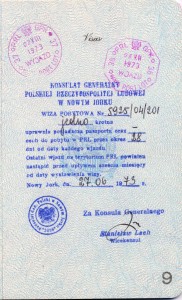
Apolonia Weglewska visited Poland from July 9, 1973 to August 7, 1973
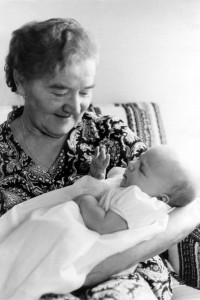
April 7, 1974: Apolonia & Marek at his Baptism
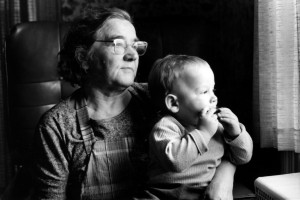
Marek & his Great-Grandmother Apolonia Weglewska (Photo by Ann Neumann; 1974)
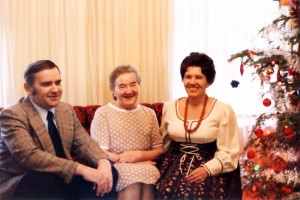
Christmas 1974: Jan Weglewski, his mother, Apolonia & Jan's wife, Kazimiera
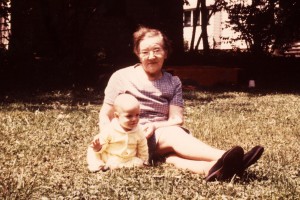
April 1976: Rysio (4 months old) with his Great-Grandmother, Apolonia Weglewska
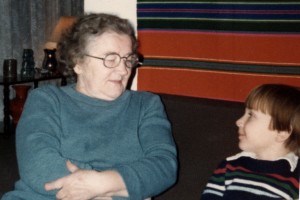
Early 1979: Marek discussing things with his Great-Grandmother Apolonia Weglewska
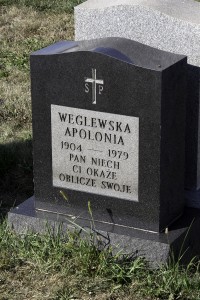
Apolonia Weglewska (January 7, 1904 - October 20, 1979) -- Our Lady of Czestochowa Cemetery, in Doylestown, Pa.
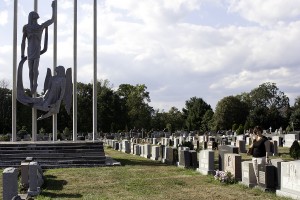
Krysia marking the location of Apolonia Weglewska's grave
William — I hope that you too will lead a very good life.
Love,
Dziadziuś Paweł.
Back to Annual Albums OR Family Letters
