Dear William (and Daniel, Catherine, Michael & Baby Girl Y) (and your parents), (and any future descendants and their parents),
Do you remember when I told you that I went to Airborne School (May – June, 1970) — well, this is how I described my adventures in the book that I wrote:
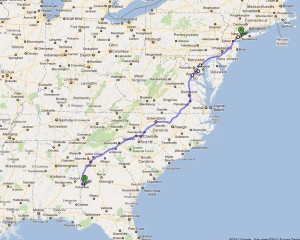
Trip, NYC to Fort Benning, Georgia
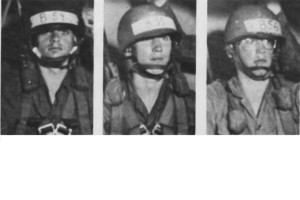
Airborne School, Fort Benning, Georgia: Class 41; 49th Company (United States Military Temporary Duty (TDY)); 4th Student Battalion (ABN); Graduation 19 June 1970; CUNY ROTC Cadets John R. Fischetti, Paul G. Kostro & Stephen P. Markardt
During the Sophomore year [in college], we were told that the Army was making some slots available for qualified ROTC students to attend Airborne School at Fort Benning, Georgia. Three of us volunteered for this, and were accepted. We drove to Georgia together; and were assigned to a single room at the Guest Officers’ Quarters. The program was three weeks long – we ran, for miles and miles; we did push ups, we did pull ups, hundreds of them, thousands of them. We learned how to fall gracefully – how to keep our feet bent at the knees; how to extend out toes; how to keep our ankles and our knees squeezed against each other, so that our two legs became one shock absorber.
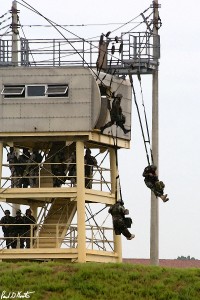
Airborne School 34-Foot Jump Tower, Ft. Benning, Georgia -- I remember my first jump (many years ago) -- I was very scared; I just had to trust that it will be OK. The training pace was fast, the sunburn was severe, the muscle pain was deep, the black-and-blue marks were painful -- and yet, I jumped, over and over again, until I learned to do it right
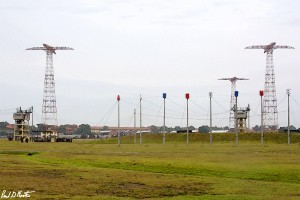
250-Ft. & 34-Ft. Jump Towers, Airborne School, Fort Benning, Georgia
We jumped from the 34-Foot Jump Towers hundreds of times; and from the 250-Foot Tower several times. The 34-Foot Jump Tower was designed to simulate the fuselage of an airplane, and the height was chosen to maximize fear, close enough so that you can appreciate the jump, and not too far away from the ground for the jumper to disassociate from reality. The first jump was a true test of my faith that the equipment would in fact keep me safe. I had to jump, with a back pack on my back, and a reserve pack on my belly. The back pack was attached to two runners which were attached to springs which were attached to a wire guide above us.
As we jumped, the looseness of the runners on each side of our head would give way to the stretching of the springs, and our bodies would bop up and down as we slid down the guide wire to a receiving mound some fifty yards away. We did this over and over, with our trainers yelling at us to keep our knees bent, to point our toes, to keep our legs tight against each other, to keep our head down for a count of five seconds – one Mississippi; two Mississippi; three Mississippi; four Mississippi, and five Mississippi. Then we were supposed to look up, and make sure that our imaginary parachute had opened.
During the third week, we would graduate, after completing five actual jumps.
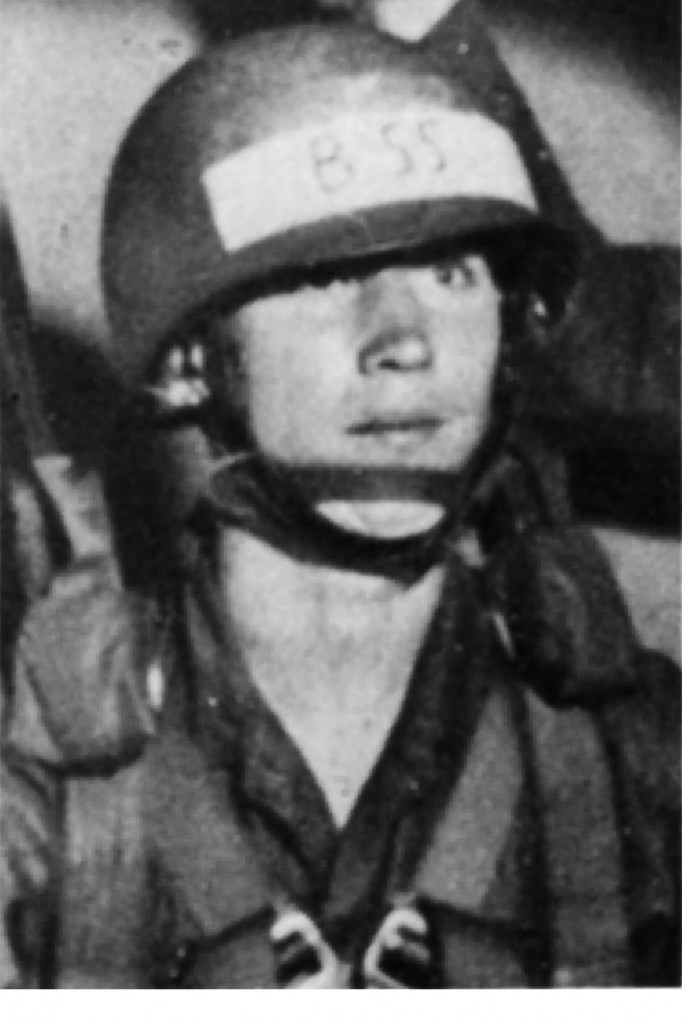
After our morning run, and other grueling exercises, we went for breakfast. Then we showered, cleaned our room, and ran out for formation. We ran in formation to the training area, and practiced our landing once again. This was not the time to break anything, as soon we would jump for real. The excitement was visible in everyone’s faces. At the appointed time, buses rode up to us, and we boarded. The trip to the airport was quick. We were assigned our real parachutes, and our spares also. The staff made sure that we had them on properly, and we were instructed, again, on the procedures we would follow.
The planes were waiting for us. We boarded and sat in two rows, facing each other, along both walls inside the airplane. There was no airline niceties – no pretty airline stewardesses, no mixed drinks, no pretzels or peanuts. It was dark green gray, and very loud. The parachute on our back made it difficult to sit comfortably, but comfort was not anyone’s concern. Surviving the day was!
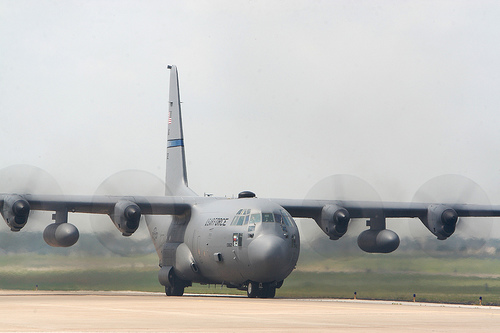
C-130
We taxied to the end of the runway, and promptly took off. I sat toward one of the ends of the row, and thus I could see out the open door. I saw the quickly passing grass and hangers further behind. I saw the ground leave us as we lifted off. The vibration and noise was so strong and loud, I could feel all the fillings in my teeth rattling. We climbed to approximately twelve hundred feed (the height of the Empire State Building), and we slowly progressed to the Drop Zone.
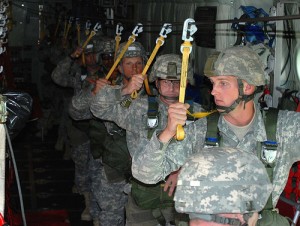
I was so scared; tears were spilling out of my eyes, I almost could not see anything, there were so many tears. Soon, the order to stand up was given. As one, we all obeyed. We turned ninety degrees, and were now facing the front of the airplane. On the command, we took the hook that we had been holding in our hand and attached it to the wire running the length of the airplane above our heads. Each one of us was checked by the one behind him to make sure that there were no kinks between the hook and the parachute on the back of the person in front of us.
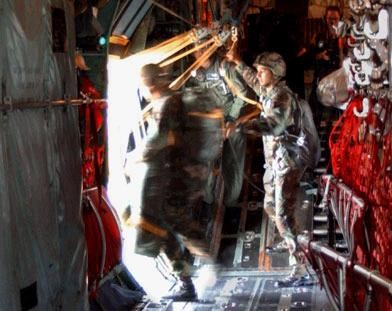
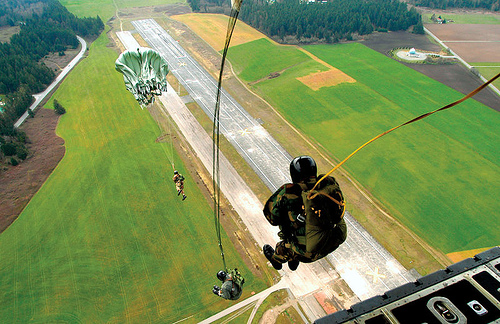
Then the stop light by the side door turned from red to green. The first person stepped up to the door, and grabbed both sides with his hands. As the jumpmaster told him to jump, he closed his eyes, lowered his head, pressed his chin against his chest, and jumped out of this perfectly good airplane. The line moved very quickly, and than it was my turn. By then, we were moving at almost a running speed, so there was not much time for reflection.
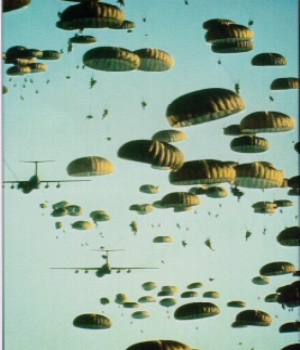
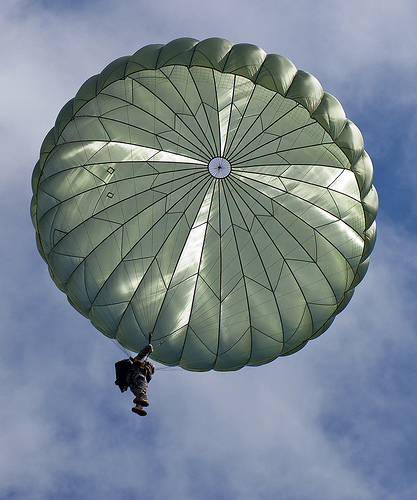
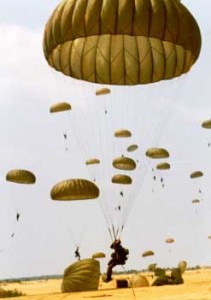
One Mississippi; two Mississippi; three Mississippi; four Mississippi, five Mississippi – it was quiet now. Unlike in the airplane, it was peaceful and light. Way below me was a field. I looked up, and I was so happy – I was looking at a perfectly opened parachute. All around me I could see the many others who had jumped with me this glorious day. Off to the side, above me, I could see the airplanes banking away from us. The trip down was approximately sixty seconds. If this had been war, these would have been sixty seconds of terror. During this time of descent, you are just hanging there, available to be shot by anyone who may wish you ill. That is why military parachutes are designed for a quick descent. It is a delicate balance, to minimize injuries upon landing, while minimizing casualties from enemy gunfire. But I was not in a war; I was having a blast!
The amazing thing is that I never felt like I was falling; it was the ground that was coming up at me. I could see that I would make contact with the ground soon, so I held on to the risers with my hands; I made sure that my elbows were touching each other, pressed against my chest. I extended my legs as much as I could, bent my knees and squeezed my legs against each other, while stretching my feet so that they would win the race to the ground.
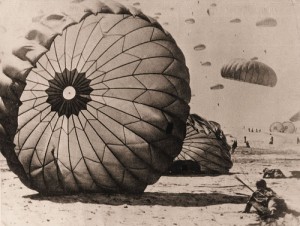
Impact was violent. I quickly got up, disconnected my parachute and ran around it to decompressed it before the wind took it away. The whole procedure was executed quickly and we gathered at our designated spot, all proud of our accomplishments. That first day, we jumped only once – the next day, we jumped in the morning and again in the afternoon. The afternoon jump was different in that I saw someone fall from the sky.
What I saw, I did not expect. He jumped, along with many others, but his parachute malfunctioned. As instructed, he made use of the spare parachute on his belly – but his position, relative to the wind, was such that he spare parachute climbed up and got stuck on whatever was there of the main parachute. The two parachutes became entangled, and somehow deflated – the fellow fell the last hundred feet or so with nothing. We were told that he broke his leg, but was alright otherwise.
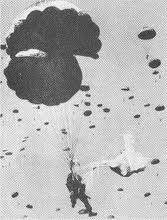
"Mea West" parachute malfunction
The next day, June 17, 1970, we were scheduled to make our final two jumps. The morning went as the previous two mornings. Once again I was next to last in my row on the airplane. I jumped eagerly, and counted to five Mississippi as I was supposed to do. But, when I looked up, things were very different. Up above me there was a giant bra – my parachute looked like two little cups with a big tangled mess in between them. This was a “Mae West,” and I had been trained for this. I immediately started pulling on my risers, trying to force them to untangle.
This time I was passing my friends – in youthful foolishness, I waived goodbye. could hear the loudspeakers on the ground, instructing all others to get out of my way, so that I would not crash into them and collapse their parachutes with my weight from above. The trip was happening much faster than ever before.
I pulled on my reserve, and it started to inflate, but as I saw just yesterday, it started to climb up my parachute and it looked like it was going to deprive me of whatever I did have to soften my landing. In that split second, I decided not to risk it, and I started pulling at my reserve to bring it back down, away from my main. The ground was coming up so very fast – it felt like I was about to be swatted by a giant pan.
I knew that the landing was perfect, although it was very hard. As I laid there in the field, I could see a medevac helicopter hovering above me. I checked my fingers in my hands and my toes – I was able to move them all – I was OK. By this time, an ambulance pulled up to me; and then I lost my ability to breathe.
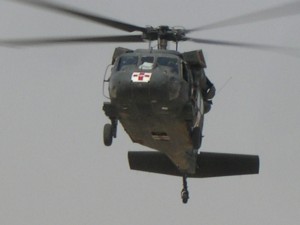
The medics worked very fast. They cut off the parachute from my body. They calmed me down, and I regained my ability to breathe. I was quickly strapped to the helicopter; and within minutes we landed at the hospital.
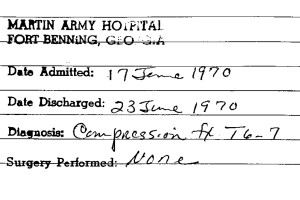
June 17, 1970: Compression fracture T-6 & T-7
I remember a group of medical personnel meeting the helicopter, just like you see on television, and pushing the gurney through the doors. I remember being wheeled into the X-ray room, ahead of the many people waiting their turn. I remember someone telling the doctors that the operating room was ready on stand by. But, thank God, the operating room was not necessary. The X-rays showed that I only suffered a compression fracture of T-6 and 7 in my spine; without any nerve damage.
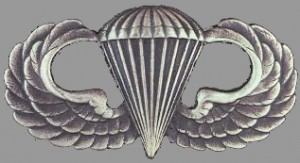
Airborne Wings
My hospital roommate was a soldier who suffered an injury to his foot – a tank drove over it. I next remember my parents and my girlfriend coming to visit, and also a senior military officer visiting and pinning my parachute wings to my pillow – apparently, I passed, even though I did not take my fifth jump. My Military Society Brothers visited, and then went back home without me.
My hospital stay was predicted to be a lengthy one – but I was macho and my doctor agreed that I could be discharged when I could do ten pushups. I left the hospital on June 23rd.
Song: Blood Upon the Risers (Gory Gory What a Hell of a Way to Die)
Love,
Dziadziuś Paweł.
Back to Annual Albums OR Family Letters
