Dear William (and Daniel, Catherine, Michael & Baby Girl Y) (and your parents), (and any future descendants and their parents),
I just saw your Dad on TV:
wtvr
Historic dig site at William and Mary in Williamsburg
Greg McQuade
2:37 PM EDT, August 11, 2011
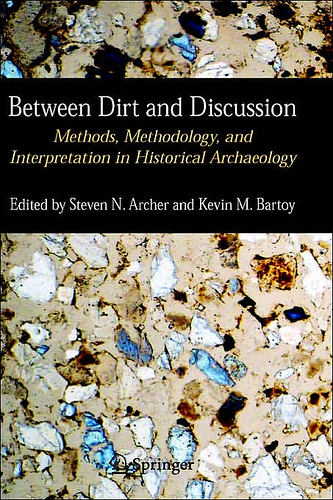
Hi Mom & Dad: I'm published! A long time coming, the book (Between Dirt and Discussion -- ISBN: 0387342184) with my chapter (Chapter 10) is finally in print as of yesterday. In addition to the chapter I wrote, Chapter 9 by Marley Brown profiles work I did for Colonial Williamsburg in 2003 and gives me a nice acknowledgement for the work. Love, Marek
WILLIAMSBURG, VA (WTVR) – It’s a classroom like no other on the campus of the College of William and Mary.
Joe Jones, Director of William and Mary Center for Archaeological Research says with excitement, “This predates the founding of our country.”
Archaeologists are digging Virginia’s past discovering artifacts that shed light on Native and African American history.
As Colonial Williamsburg archaeologist Mark Kostro sifts through pales of dirt he says, “It could be wine bottle glass.. fragments of pottery… architectural debris like nails and window glass.”
At two sites on campus just a few yards apart – archeologists are finding links to Brafferton, an Indian school for boys dating to 1697, and the foundation of a kitchen building thought to be used by slaves.
Jones says, “The story of slaves who were fundamental of the operation of this college is largely untold.”
Written histories of these populations for the most part just don’t exist. So pieces of the past no matter how big or small are key pieces to the puzzle.
For Archaeologist Jeff Brown – a member of the Pamunkey Indian Tribe this particular dig at a site used by his ancestors is most gratifying.
“We found three cannon balls. When I started it was satisfying. But when I started working it was unbelievable.”
If you look inside one of the plastic bags used by the archaeologists you’ll find pieces of brick, broken glass and oyster shells. To someone in the 18th century it was trash. Fast forward to the 21st century. To an archaeologist? The bag is filled with gold.
Jones says, “There is no question that archaeology can play a role of telling us about that significant time in history.”
The archaeologists spend countless hours, scraping and searching for historic treasures, but they can think of no other place they’d rather be.
Kostro says, “It takes a lot of time and patience. We want to make sure we capture everything we find. You only get one chance at archaeology. You don’t know what it is each bucket.”
=====================
That was exciting!
Love,
Dziadziuś Paweł.
Back to Annual Albums OR Family Letters
