Dear William and Daniel, (and Catherine, Michael & Baby Girl Y) (and your parents), (and any future descendants and their parents),
Today, let us concentrate a bit on: Who Is Daniel?

Daniel Sasieta
But, think about it; look at his picture closely — do you see anything special? Notice the lion on his chest? Might that give us a clue?
So, let us do some research — it appears that there are many Daniels in the world; but, there is a particularly famous Daniel — a biblical Daniel — he is the protagonist [i.e., the main character] in the Book of Daniel of the Hebrew Bible (some of us call this the Old Testament). The Roman Catholic Church commemorates St. Daniel on July 21 — this is the date of Daniel’s Imieniny or Name Day (you may want to read my prior description of the meaning of Imieniny or Name Days; where I also discuss William’s Imieniny).
So, what is the clue on Daniel’s chest — the lion?
Well, it seams that the biblical Daniel had a brush with lions — the story of Daniel in the lions’ den is found in the sixth chapter of the Book of Daniel. According to this story, Daniel was an official in the Persian empire under King Darius. King Darius (at the instigation of his other officials) had made a decree that no-one was to offer prayer to any god or man except him for a period of thirty days. Notwithstanding this decree, Daniel continued to pray to God, as was his habit, knowing that such praying would have him killed. For this action, King Darius had him arrested and thrown into a lions’ den.

Daniel’s Answer to the King, painting by Briton Rivière
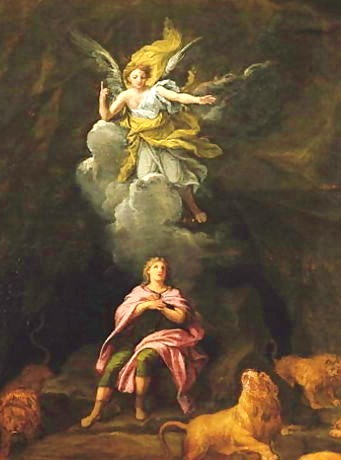
Daniel In The Den Of Lions, painting by Francois Verdier
However, protected by an angel, Daniel was unharmed, and after he was released the following morning, the people who had cajoled the king into making the decree (which was for the sole purpose of getting at Daniel) were thrown into the lions’ den themselves, where they were consumed by the lions.

Belsazar’s Feast, painting by Rembrandt
Another story related to Daniel concerns “The hand writing on the wall” (or “the handwriting on the wall” or “the writing is on the wall” or “Mene Mene”), which is an idiom for “imminent doom or misfortune” and for “the future is predetermined”.
The expression originates from the book of Daniel Chapter 5, where it is describe how handwriting on the wall was witnessed at a banquet hosted by King Belshazzar. As those at the feast profaned the sacred vessels pillaged from the Jerusalem Temple, a disembodied hand appeared and wrote on the palace wall the words, “Mene, Mene, Tekel, u-Pharsin.”
Daniel was summoned by the King to interpret this message — Daniel interpreted this message as the imminent end for the Babylonian kingdom. That night, King Belshazzar was killed and the Persians sacked the capital city.
As you can see, our names are not meaningless — they originate from a rich past, and we are each charged with protecting that good name, and making our own contributions to mankind, so that others, in the future, may remember our names, and say: “That was a good person.”
Love,
Dziadziuś Paweł.
Back to Annual Albums OR Family Letters
