Dear William (and Daniel, Catherine, Michael & Baby Girl Y) (and your parents), (and any future descendants and their parents),
I just got back from court, and my heart is broken. But, let me back up, and tell you the whole story …
You already know that I went to law school, and therefore you may not be surprised to find out that I am an attorney. As an attorney, I have a duty to my clients; and I have a duty to the court.
A couple days ago, I received a letter informing me that I needed to be in court today, before Judge Walsh, to represent (for free) an individual who has been accused of violating a restraining order – that is, an order issued by the court, forbidding my client from contacting the person (my client’s Girlfriend) who originally filed a complaint for harassment against my client. The violation was a phone call by my client, where he said some nasty things to his Girlfriend.
Shortly after I received the letter appointing me as counsel for my new criminal client, I received a telephone call from the Girlfriend — she told me that she went to court, and convinced a judge to dismiss the restraining order. I explained to her that the fact that the restraining order had been dismissed does not help my client very much; because, at the time that he made the nasty phone call, the restraining order prohibited him from making the call.
The Girlfriend went on to tell me that my client did not understand that he could not call her because he is “slow” and he is illiterate – that means that he cannot read.
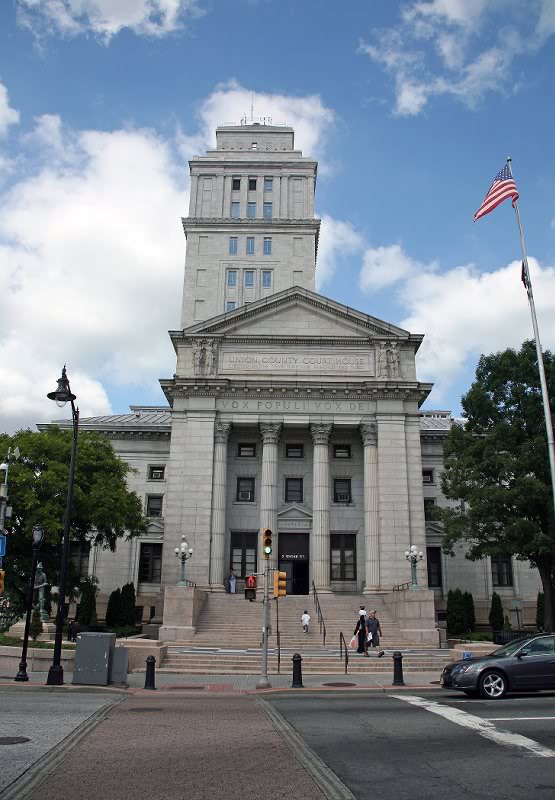
Union Co. Courthouse
Today, I went to court, at the Union County Courthouse, in Elizabeth, N.J. There, I went to the fourth floor of the “Rotunda” building, where Judge Walsh has his courtroom. Because I was early, I had to wait a bit. But then, someone came out of the courtroom, and told all of us waiting that Judge Walsh was not in today; and his “calendar” (that means, his cases) is being handled by Judge Alcazar today, who is in the “New” building — the Union County Courthouse is made up of four different buildings, but because they are interconnected, people sometimes are confused which building they are in; but, the “New” building is easy to find because it is detached – that means, you have to go outside, and have to be screened all over again to go into the “New” building. Anyway, I finally got there.
Judge Alcazar
When I arrived, the Sheriff’s Officers did not know that my client was still in jail (he had been there for about two weeks, because he did not post bail). After some checking, they located my client, and had him bought over from the jail (the jail is across the street from the courthouse).

When I met my client, I asked him to read a simple sentence – he could not read it. Although he finished the 11th grade, he never learned to read.
When I asked him about the alleged violation of the restraining order — he told me that he just received the order the night before, when a police officer delivered it to him, but he did not read the order, and he did not realize that it prohibited him from making a telephone call to his Girlfriend.
After that, I spoke with the prosecutor (a very nice fellow), who gave me a document called a Plea Offer. I then went to discuss the Plea Offer with my client, who was handcuffed to several other prisoners in a narrow hallway that was locked from both sides. I explained to him that the State was offering to dismiss the pending Harassment charge against him, if he pleads guilty to violating the restraining order, and the recommended fine was the required minimum of $125. There would be no probation, and no jail term and no additional fines. Thus, if he pleads guilty, he can get out of jail today!
My client told me that he wants to plead guilty, and get all of this behind him. I explained to him that although the Plea Offer may sound attractive, if he is EVER found guilty of violating any other restraining order in the future, the judge then will have NO CHOICE but to send him to jail for at least 30 days. My client thought about it, and decided that he did not care, and he just wants to get out of jail today, so he is going to plead guilty.
When our case got called by the Court Clerk, I told the judge that my client wants to plead guilty; BUT, I, as an officer of the court, feel obligated to inform the court that there may not be a factual basis for the plea, and therefore, I feel obligated to challenge the court’s subject matter jurisdiction in this case under the U.S. Constitution and the N.J. Constitution – specifically, because my client could not read, and did not understand that he was prohibited from making the phone call to his Girlfriend, he did not receive Due Process.
Well … the courtroom went silent. The prosecutor made various arguments; but, clearly the judge was very much intrigued by my “novel” argument. The judge asked me and the prosecutor to come up to the judge’s bench (I think that the judge did not want everyone else to hear what he was about to say to us), and proceeded to tell the prosecutor that there is much merit to my argument, and asked the prosecutor if he was ready to go forward with this issue all the way up to the Supreme Court; perhaps, as an act of prosecutorial discretion, he should just dismiss the case, especially that the Girlfriend was the one who dismissed her complaint that gave rise to the restraining order.
The prosecutor thanked the court for its guidance, but stood his ground – he would not dismiss the case at this time. The prosecutor asked for two weeks to investigate the matter, and then, if appropriate, to proceed to trial. I, on the other hand, knew that my client did not want to wait two more weeks in jail.
I asked the judge to reduce the bail to zero, so that my client could go home today; and we would address the other issues in two weeks. The prosecutor responded that ONLY the judge that set the bail in the first place could reduce it. Judge Alcazar telephone that other judge, but he could not be reached because he was on the bench handling his own cases. So, we waited for a phone call back.
I spoke with my client again, and he told me that he is aware of the issues, but he just wants to go home, and he is ready to plead guilty right now.
After the judge handled a few other cases, he got back to my case. I explained that my client wants to plead guilty, but, as I stated before, I an not sure if a factual basis can be established. By now, the Sheriff’s Officers were getting ancy because it was getting late, and they needed to take the prisoners back to jail.
The judge was clearly eager to deal with the Constitutional issue, but we could not address it today. My client continued to insist that he wants to plead guilty. So, we (the judge, the prosecutor and I) agreed that we will allow my client to testify, and depending on what he says under oath, the judge will accept the plea from my client, or we will have to wait for another court hearing.
My client was sworn in. The judge warned the prosecutor that he needed to prove every aspect of his case beyond a reasonable doubt. I kept my fingers crossed.
Then, my client testified under oath that he was served with the restraining order in the evening before he made the phone call. He made the phone call knowing that he was prohibited from contacting his Girlfriend. He knew that “contacting” included making phone calls; and he knew that because the police officer who served him with the restraining order told him so.
By now, it was late in the afternoon. Fortunately, the judge was not displeased with me for disrupting his routine day. My client went off happy, because he was getting out of jail; and I went back to my office to prepare for a trial in another matter, which will continue on Monday.
So often, clients are their own worst enemies. They lie at first (about how he did not understand that he was prohibited from making the phone call), but then, they focus only on the short term, and forget about the long term implications.
— William, always be aware of the long term; and act accordingly.
Love,
Dziadziuś Paweł.
Back to Annual Albums OR Family Letters
