Dear William (and Daniel, Catherine, Michael & Baby Girl Y) (and your parents), (and any future descendants and their parents),
Yesterday we studied Mathematics; today, lets take a look at Poetry.
One form of poetry is knows as Haiku.
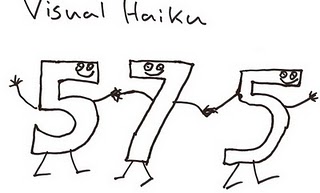
5 – 7 – 5
Haiku is a poetic form and a type of poetry from the Japanese culture. Haiku combines form, content, and language in a meaningful, yet compact form. Haiku poets write about everyday things. Many themes include nature, feelings, or experiences. Usually they use simple words and grammar. The most common form for Haiku is three short lines. The first line usually contains five (5) syllables, the second line seven (7) syllables, and the third line contains five (5) syllables. Haiku doesn’t rhyme. A Haiku must “paint” a mental image in the reader’s mind. This is the challenge of Haiku – to put the poem’s meaning and imagery in the reader’s mind in EXACTLY 17 syllables over just three (3) lines of poetry!
[William — all words have at least one syllable. Syllables are chunks of sound and can be just on letter or groups of letters; it’s the sound the matters. One way to understand what syllables are is to think of a song, like “Happy Birthday.” Each syllable is a different beat in the song, i.e., “Hap – py Birth – day to you …”]
Here are two examples (which I did NOT write) of Haiku:
The Rose
The red blossom bends
and drips its dew to the ground.
Like a tear it falls.
A Rainbow
Curving up, then down.
Meeting blue sky and green earth
Melding sun and rain.
The most common variation from the three-line standard is one line, sometimes known as monoku.
Examples: (1) “listen to the pause – silence is golden”; and (2) “the snow covers the pasture – the haystacks disappear”
Haiku of four lines (known as haiqua) or longer have been written; sometimes, as “vertical haiku,” with only a word or two per line. These poems mimic the vertical printed form of Japanese haiku.
A Vertical Good-bye Haiku
said
she’d
never
leave
was
until
death
do
us
part
guess
death
knocks
early
Haiku have also appeared in circular form (sometimes known as cirku) whereby the poem has no fixed start or end point.

Cirku: Locked in a tower
In the “zip” form, a haiku of 15 syllables is presented over two lines, each of which contains one internal caesura (a pause), sometimes represented by a double space.
the lambs leap up like foolish children
unaware they are sheep
fireflies…one before another
….wink…through the night
………………………….on the chimney…tap-tap-tapping
……………………a woodpecker…at first light
A fixed-form 5-3-5 syllable (or 3-5-3 word) haiku is sometimes known as a lune.
-Three lines containing a syllabic count of 5-3-5.
-A complete thought within those three lines (thirteen syllables).
or:
-Three lines containing a word count of 3-5-3.
-A complete thought within those three lines (eleven words).
The Lune doesn’t have the same restraints as Haiku. You may refer to the seasons or not. You may rhyme or not, generally a no-no in Haiku. You may also use metaphor, simile, etc. Which is frowned upon in Haiku. This is a form with great latitude.
My Lune for William:
You Are William
You Are My First Grandson
I Love You.
Hey, William — did you know that we have at least one poet in our family! Yes — my Brother Tom’s wife, Patty, is a published poet!

Patty Brody, with a September 6, 2001 letter from The Paris Review
The Paris Review
September 6, 2001
Dear Ms. Brody,
The Review is delighted to have “Dangerous to Know,” for which you will receive (eventually) galleys and a tiny check. …
[NOTE: “Dangerous to Know,” is a series of poems in the voices of lost literary-historic women.]
Excerpt from Dangerous to Know
“Mad, bad, and dangerous to know”
Lady Caroline
Lamb’s journal entry, on first meeting Lord Byron, 1812
I’ve been chilling with these dead people,
not just reading their letters and poems
but going to their balls.
I’ve been under their clothes
in their skins,
sticking to dampened petticoats
and floaty muslin.
I’m at Devonshire House;
Lady Someone is my mother.
At Brocket I’m running through the trees,
a lordly satyr at my heels, his lip
curled, his brow furred, pale skin agleam…
Fly me, says the mad corsair.
Deep-drugged in the night
I creep from bed, Lord M stretched
senseless beside me.
Down through Georgiana’s garden
I fall, down to the white hawthorn…
==========
William, can you write a Haiku or a Lune?
Love,
Dziadziuś Paweł.
Back to Annual Albums OR Family Letters
